Europe and China in the Western Indian Ocean: Shared Waters, Distinct Courses
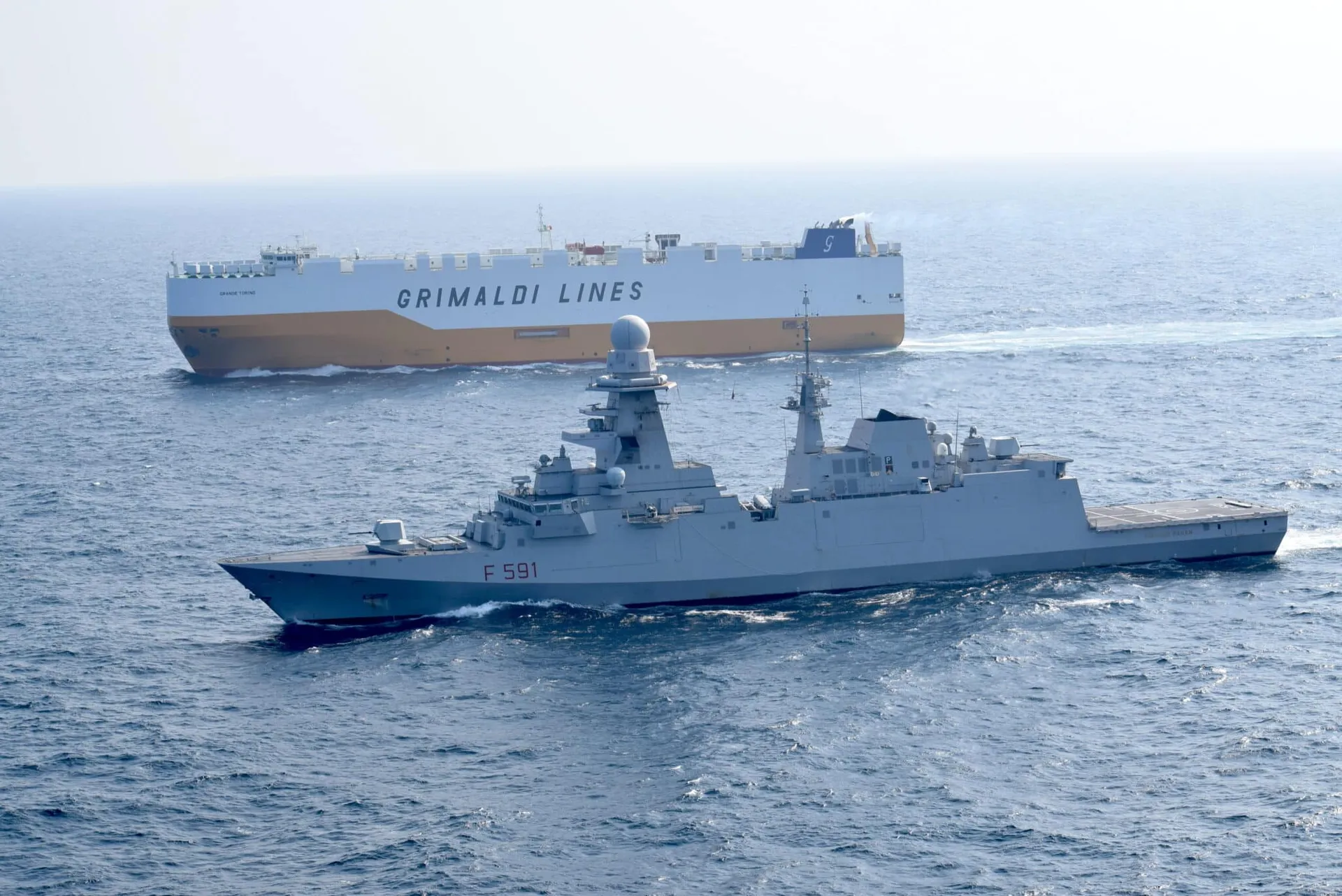
Source: Italian Navy
Commentary by Alec CARUANA, Non-resident Research Associate,
December 16, 2025
Rising maritime insecurity in the Indian Ocean exposes Europe’s trade vulnerabilities and declining US commitment. While Europe relies on fragmented multilateral tools, China pursues a strategic, well-resourced presence. Despite differences, both share interests in secure sea lanes and sustainable maritime development, creating scope for pragmatic cooperation.
Earlier this spring, the Houthi Movement in Yemen’s escalation of attacks
on commercial shipping vessels in the Red Sea drew global attention to the wider maritime environment
of the Western Indian Ocean. While these raids drew concern across the world over their impact
on global supply chains, Washington’s intervention provoked unease in European capitals for more
profound reasons. In the course of U.S. deliberations over a potential military response, a private
Signal chat between senior Trump administration officials was leaked, revealing
candid assessments
of Europe’s dependencies on Indian Ocean trade routes: “I just hate bailing Europe out again.”
Vice-President JD Vance wrote, with his colleague in the Pentagon, Pete Hegseth responding, “I
fully share your loathing of European freeloading. It’s pathetic.”
As 2025 draws to a close, while the regional security environment has shifted significantly, Europe’s
trade with Asia remains vulnerable. Washington’s ostensible
neutering of Iran’s nuclear threat
and success in
brokering a tenuous ceasefire
between Israel and Hamas has contributed to a relative reduction in regional military tensions
in key marginal seas to the Indian Ocean—namely the Red Sea and the Gulf of Hormuz. However, piracy
and other forms of maritime insecurity
continue to disrupt shipping
and will continue to pose challenges to consumers and policymakers across Europe and Asia. With
American commitment to securing these arteries demonstrably vacillating and the transatlantic cooperation
over Indian Ocean maritime affairs weakening, exploring how interests align across east-west lines
and what potential could come through enhanced cooperation is certainly warranted.
Europe’s Interests in the Indian Ocean
For most of Europe, the Indian Ocean is not a far-flung or abstract theatre—the Suez Canal has
made the sea significantly interdependent with the Mediterranean, with
over one-third
of the EU’s external trade passing through its sea lanes. These vital maritime shipping lanes connect
Europe to energy suppliers in the Persian Gulf, manufacturing hubs in East Africa and South Asia,
and consumer markets in Europe. Nevertheless, Europe’s substantive maritime engagement remains
relatively piecemeal. For the traditional ‘heavy-hitters’ in Europe’s security apparatus, the region
features in their broader Indo-Pacific strategic calculus. France stands out as the only EU member-state
with permanent territories and forces in the region—Réunion, Mayotte, and a non-trivial
military presence in Djibouti
giving Paris both the means and the incentive to pursue an active regional policy. Across the English
Channel, moves by the UK government to
transfer sovereignty of the Chagos Islands to Mauritius
suggests a potential deemphasis of the Indian Ocean in this government in London’s long-term maritime
strategy.
For most other European states, lacking such forward-deployed assets or
national contingents, they contribute to regional efforts primarily through multilateral
frameworks to promote supply chain security rather than independent deployments. The EU’s
flagship presence is ‘Operation Atalanta,’ (formerly known as EUNAVFOR Somalia) launched in
2008 to counter piracy off the Horn of Africa. The mission,
still active today, now focuses on maritime awareness, regional capacity-building, and escorting humanitarian
shipments. Alongside Atalanta, the EU also launched ‘Operation Aspides’ in 2024 with a mandate
specifically to
defend against Houthi attacks
against European-flagged commercial vessels. Nevertheless, coordination beyond surface level security
efforts often remains a challenge. Given the aforementioned asymmetries in member-states’ regional
presence, they often approach the Indian Ocean through distinct lenses rather than as a unified
strategic space. For example, Italy’s engagements with Mozambique are driven largely by
energy interdependencies,
while French and Portuguese military ties with this nation also center on
threats of insurgency
spilling over into EU overseas territories and surrounding seas. This fragmentation stands in contrast
to the coherence of China’s regional approach.
The Chinese Approach
The Indian Ocean has
also become indispensable for Beijing. About 80 percent of Chinese oil imports
flow through its waters, largely via the Strait of Hormuz and the Strait of Malacca. The region is also the maritime
spine of the Belt and Road Initiative—also known in-part as the ‘Maritime Silk Road’
concept—connecting ports across Africa, the Middle East, and Europe. Over the last decade,
China has financed and built a series of mega port and infrastructure projects, from
Hambantota in Sri Lanka
to
Lamu in Kenya
to
Bagamoyo in Tanzania. The logic behind such investments is both commercial and strategic. They secure logistics
routes for Chinese trade while deepening political relationships with host countries.
Meanwhile, China's military footprint has expanded in tandem. Since 2008, the
People's Liberation Army Navy has deployed over forty task forces for anti-piracy patrols
in the Gulf of Aden, making it a
consistent actor
in regional maritime security. In 2017, Beijing
opened its first overseas military base, in Djibouti, to serve as a logistical hub for those patrols and allow long- range
operations, while also serving as a platform for Chinese power projection and naval
experimentation. Taken together, these elements provide what some analysts in the past decade
have termed China's “string of pearls”: a network of commercial and quasi-military assets that runs from the South China Sea
through the western Indian Ocean.
While the contrast is not an absolute one, it is
clear that Europe and China approach the Indian Ocean with slightly different priorities,
methods and intensity. Largely lacking independent capacity to project power, European states’
regional engagements mainly
depend on
multilateral frameworks, normative commitments, and partnerships with regional actors. In fact,
the majority of EU members states’ military deployments (such as the aforementioned EUNAVFOR)
overlap with those of other countries
through the Union’s Common Security and Defence Policy (CSDP) and occur at the behest of local
countries; direct and unilateral actions by European armed forces (such as France’s counterinsurgency
operation in the Sahel) are few and far betweeen. This tends to stall decision-making, reducing
operational flexibility and substantive impact. By contrast, China prioritizes strategic resilience
and presence in key maritime nodes through infrastructure development and naval presence, thereby
enabling rapid, unilateral responses to potential disruptions.
Areas of Potential Alignment
Despite these differences, Europe and China share certain pragmatic interests. Both depend on the
uninterrupted flow of commerce through the Red Sea, the Gulf of Aden, and the wider Indian Ocean.
Both have experienced disruptions caused by piracy, terrorism, and, more recently, drone and missile
attacks by the Houthis. Throughout the recent Red Sea crisis, Chinese and European shipping companies
faced similar risks, prompting their respective navies to participate in convoy and escort operations
coordinated via existing anti-piracy security architecture
created in the 2000s. Both polities have also issued public statements emphasising the need to
preserve navigation rights under international law despite regional insecurity—take, for example,
the mirrored
EU
and
Chinese
responses to Houthi attacks on European vessels in July.
Another potential point of
convergence is sustainable maritime development. The EU’s
Global Gateway Initiative
and several projects funded under China’s aforementioned Maritime Silk Road framework both place
an emphasis on sustainable infrastructure and economic capacity- building among coastal states
along the Indian Ocean’s rim. Both polities have been seeking partnerships with East African countries—in
fact, efforts overlap in Mozambique where European and Chinese policy banks have both deployed
large-scale investments under the
Global Gateway
and
BRI
umbrellas to develop economic corridors linking ports to inland areas. Though means differ—EU actors
largely through grants and regulatory standards, and China largely through concessional loans and
construction contracts—goals and targets overlap significantly. Expanding cooperation into fields
such as green port development or marine environmental impact presents low-hanging fruit to both
sides, provided trust can be built consistently.
With Europe’s capacity to project
power in the region independently likely to remain limited, the Western Indian Ocean will
likely remain a space where Europe and China are compelled to coexist rather than compete
outright. Both depend on its sea lanes, both seek predictability, and both face the same
volatility at its chokepoints. The difference lies in method and intent: China’s approach is
strategic, centralized, and well-resourced, while Europe’s remains ambivalent, diffuse, and
constrained by relative power deficiencies. Bridging that gap will require more than rhetoric
about a “rules-based order.” It must start with sustained investment from both sides in
developing a maritime trading economy with high-quality standards (for example, in energy
efficiency, sustainability, and local inclusion) that capitalize on slackening standards and
reduced enthusiasm from other global actors for development finance. Europe must also work
towards bringing about greater policy coherence between EU institutions, its member-states,
and Trans- Atlantic security architectures. Most importantly perhaps, the EU and China must
continue to demonstrate a readiness to mutually engage where interests overlap in the maritime
space without forfeiting their ability to secure economic returns and sustain growth at home.
Please note that views expressed by the author do not reflect the policies or positions of ICES.