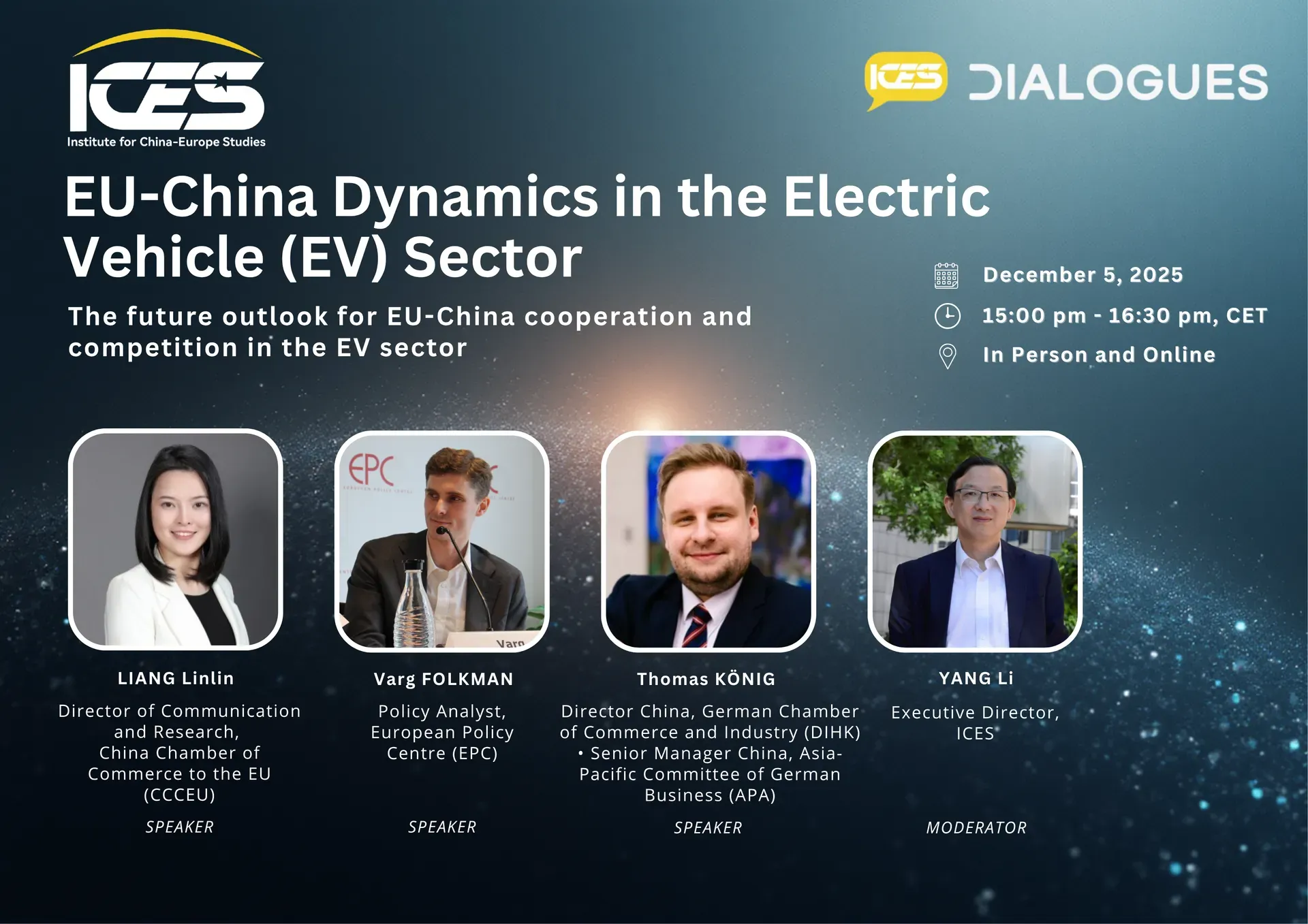
EU-China Dynamics in the Electric Vehicle (EV) Sector
Hosted by the Institute for China-Europe Studies (ICES)
December 5, 2025
Source: ICES
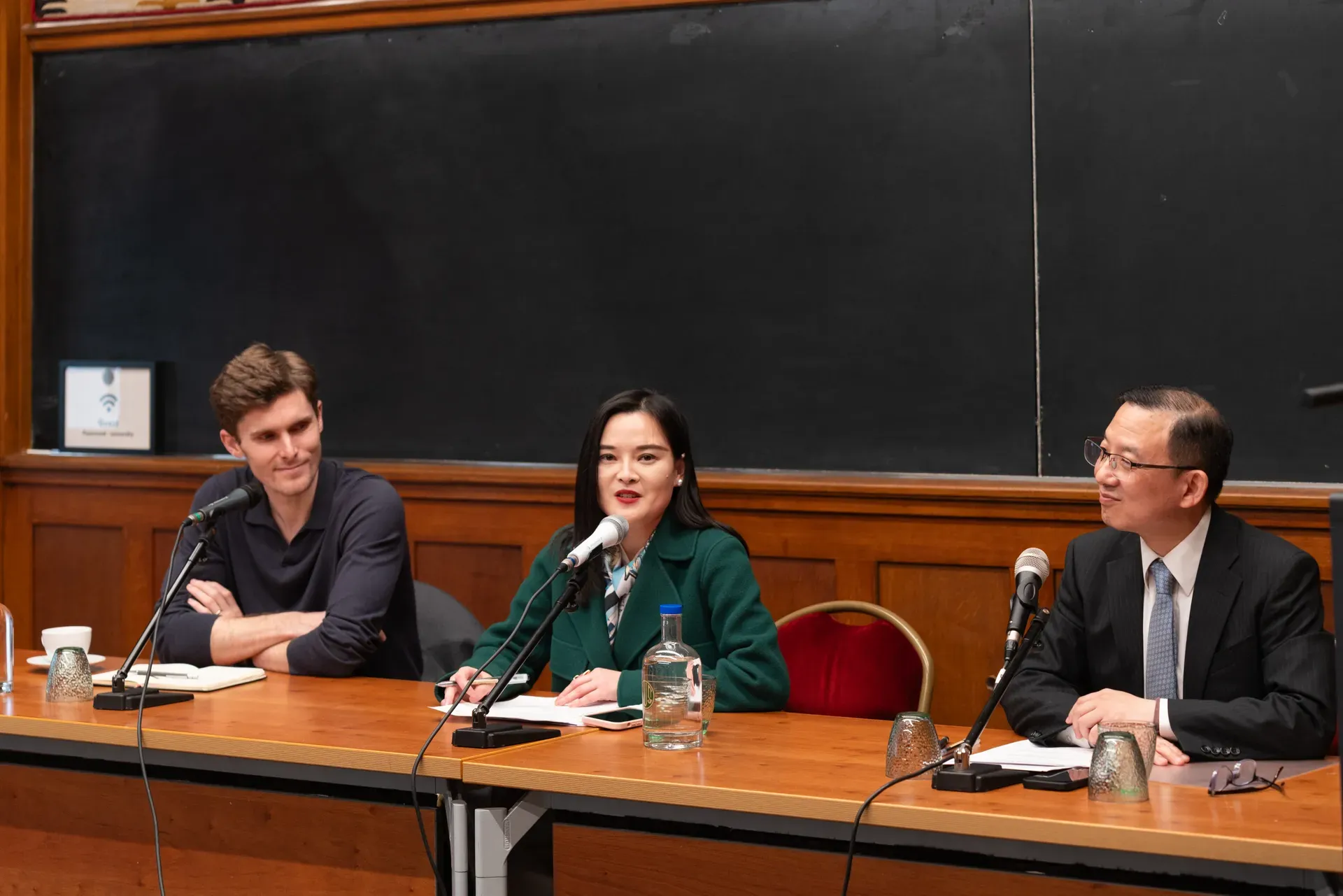
On Friday 5 th December, ICES organised and hosted a seminar on EU-China Dynamics in the Electric Vehicle (EV) Sector
at the University Foundation as part of the closing session of our “Dialogues” series on 50 years
of EU-China relations.
In October 2024, EU member states voted to impose five-year
countervailing duties on imports of Chinese battery electric vehicles (BEVs). One year later,
negotiations on a potential “price undertaking” remain unresolved. In September 2025, China
announced that, starting from January 2026, exports of EVs will be subject to an export
licensing system. On the EU side, investigations into Chinese industrial subsidies are
continuing. At the same time, recent developments in chips have added a new layer of
complexity to future of EU–China automotive cooperation and supply chains.
ICES was pleased to welcome:
Our Executive Director Mr YANG Li moderated the event.
The speakers shared their analysis on the state of EU-China EV relations, described the
current challenges for Chinese and European companies, the reasons for price undertakings’
lack of progress and the new EU economic security doctrine.
The event was the occasion for the speakers to highlight the often necessary cooperation between
Chinese and European auto-makers on standards and innovation, since both sectors are intertwined.
Moreover, and despite the very assertive rhetoric of European institutions on the EVs’ competition,
the total market share of European companies in EVs worldwide (just 5% for German ones) might not
justify defensive European measures as it is probably too late to compete with the Chinese EV industry,
which is not also not that present in Europe at the moment. The geopolitical factors then, both
from the US pressure and the domestic push for de-risking, might better explain the current EU’s
scramble for tariffs, re-localisation and investments’ new rules.
Looking ahead,
further challenges for Chinese companies include the lack of Chinese brand awareness in Europe
and navigating the geopolitical uncertainties despite an established interdependence. On the
European side, speaking with one voice on the matter will necessarily require further internal
negotiations on the matter before true breakthroughs on negotiations on price undertaking can
happen bilaterally.
We extend our sincere thanks to the speakers for their
insightful contributions and to our engaged audience for their participation.
If you were unable to follow the discussion live, we invite you to watch the full recording via:
https://www.youtube.com/watch?v=gCvYd4pZ4Lw
Source: ICES
Source: ICES

Source: ICES

Source: ICES