From Doctrine to Practice: Europe’s Economic Security Evolution and the Business Reality in EU-China Relations
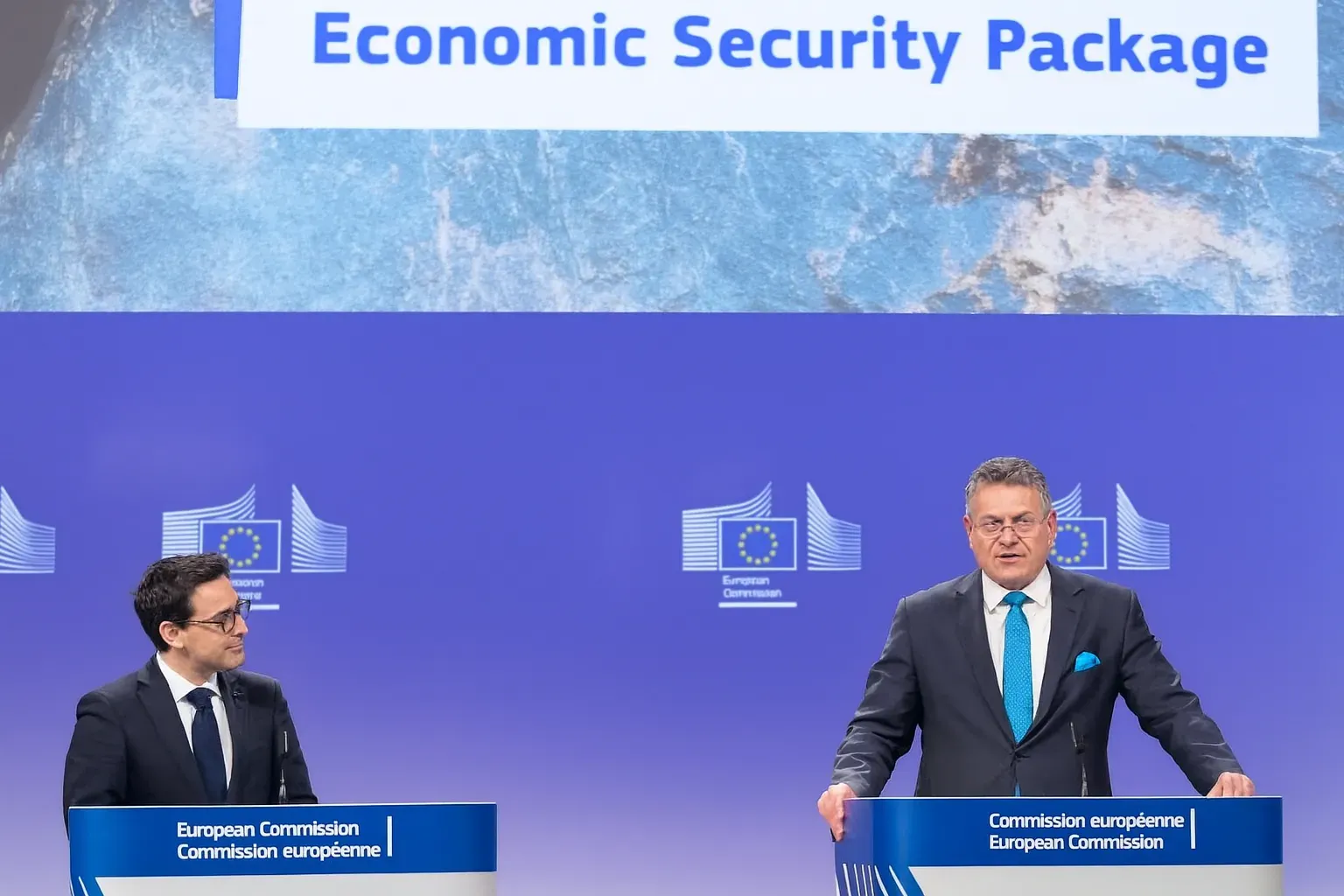
Source: European Commission
Commentary by Linsheng Hong, Research and Management Associate, ICES
December 12, 2025
The EU’s new economic security doctrine signals a shift toward proactive “risk” management and anticipatory governance. While intended to reduce strategic dependencies, its practical meaning remains unclear. Diverging policy ambitions and deep EU-China interdependence risk creating uncertainty unless security measures remain targeted, proportionate, and predictable.
Evoluated Economic Security: from reactive to proactive
The EU’s new Joint Communication on Economic Security,
released on December 3 marks a decisive turn in Brussels’ approach to managing economic risks.
Rather than reacting to crises, the EU is now moving toward what it calls a “proactive and targeted”
strategy for identifying and
mitigating strategic dependencies
and vulnerabilities. The communication outlines six priority risk areas: reducing dependencies,
attracting secure investment, boosting critical industries such as defence and space, maintaining
tech leadership, protecting sensitive data, and safeguarding infrastructure.
At
an EPC event illustrating the doctrine
on December 9, speakers described the doctrine not as a completed framework, but as the
starting point for future policy tools and more consistent coordination. It builds on the EU’s
2023 economic security agenda, which focused on three pillars: promoting industrial
competitiveness, protecting strategic interests, and partnering with trusted countries. The
current doctrine, as synthesised by the speakers, shifts emphasis toward “preparation” and
“anticipatory” governance. Denis Redonnet, Deputy Director-General of DG TRADE, highlighted
potential measures under discussion. These include the launch of the
ResourceEU
platform to manage critical raw material risks, the adoption of binding principles for the
consistent use of economic security instruments in high-risk sectors, the appointment of
national economic security advisors, and improved mechanisms for sharing information across EU
institutions, member states and private industry, etc.
This evolution of economic security has attracted attention from policy analysts, who see the
doctrine as part of a broader recalibration of the EU’s economic governance. Bruegel experts,
in
a recent policy brief,
highlight the EU’s need to reduce strategic dependencies while maintaining its capacity to respond
swiftly to economic coercion. The European Policy Centre analysts define the doctrine as a transition
from reactive crisis management to long-term strategic planning, and as a first step in
consolidating the EU’s economic security architecture.
MERICS researcher argues that the doctrine could provide a basis for ensuring that Chinese investments
deliver “real” benefits to Europe. In greenfield foreign direct investment, it could include introducing
EU-wide minimum requirements
such as local content rules and encouraging Chinese original equipment manufacturers to co-fund
local research partnerships.
Business Voices Call for Greater Clarity
However, such a doctrine still lacks a clear understanding of what it entails in practice,
how it will be implemented,
and who will bear the operational costs. While European business communities support the goal of
building more resilient supply chains, they remain concerned about the execution of these ambitions
and their economic consequences.
One week after the doctrine was released, the European Union Chamber of Commerce in China (EUCCC)
published
Dealing with Supply Chain Dependencies: Challenges and Choices (2025).
The report welcomes the strategic intent behind resilience-building but cautions against
miscalibrated security measures that could fragment supply chains, raise costs, and slow
innovation. It highlights China’s centrality in global manufacturing networks, describing it
as the world’s “only manufacturing superpower,” and points out that many European firms remain
deeply reliant on Chinese industrial ecosystems. The report also warns that national security
rationales can be inconsistently applied and, at times, may serve objectives unrelated to
genuine security threats.
In response, the EUCCC calls for clearly defined, proportionate tools and stresses the need
for close consultation with industry to ensure that regulatory measures are both targeted and
practical. This concern is reinforced by another
EPC commentary,
which emphasises that economic security can only succeed with regular dialogue with the private
sector, which often acts as an early-warning system for disruptions and coercion. It warns that
without clear objectives, legal certainty, and proportional application of rules, the doctrine
risks generating internal fragmentation within the Single Market itself. Similar policy-level critique
is also mirrored in business perceptions. At
an event
organised by Institute for China-Europe Studies (ICES), a German business representative described
the growing tension between de-risking ambitions and the reality of deep economic interdependence
as a source of strategic ambiguity. Without a clearer long-term EU-China framework, he argues,
companies increasingly struggle to anticipate how policy choices will affect market access, investment
decisions and supply chains over the coming decades.
The View from the Ground: CCCEU and EUCCC Annual Reports
These calls for clarity and proportionality are grounded in operational realities. The China Chamber
of Commerce to the EU (CCCEU)’s annual report on
the Development of Chinese Enterprises in the EU 2025/2026
published in November and the EUCCC’s
European Business in China Position Paper 2025/2026
published in September provide a dual perspective on how economic security debates are reshaping
business perceptions and strategies on both sides.
Based on 205 Chinese companies operating in the EU, the CCCEU report portrays Chinese companies
operating in Europe as broadly resilient, with 84% reporting stable or improved performance in
2024. Yet concerns are mounting: 90% of surveyed firms say that EU de-risking policies have impacted
their confidence or operations. Over 40% report experiencing discrimination, and 63% say they have
been affected by the European Commission’s enforcement of the Foreign Subsidies Regulation (FSR).
Many firms express anxiety about the politicisation of commercial activities and the blurring of
economic security with industrial protectionism.
Recent developments also further
illustrate the sharpening focus on Chinese firms within the EU’s economic security agenda and
heightened sensitivity to local integration. In November 2025, Reuters
reported
that
CATL and Stellantis’s plant in Spain
is expected to create up to 4,000 jobs in late 2026, with local employees eventually
comprising more than 90% of the total staff. Within one week in early December, the European
Commission opened an
in-depth FSR investigation
into Chinese security firm
Nuctech
and
raided Temu’s Dublin office
over subsidy concerns.
Meanwhile, reflected by 503 European companies operating in China, the EUCCC’s Position Paper paints
a more pessimistic picture of operating in China. 73% of surveyed firms report that doing business
in China has become more difficult. Only 12% of European firms expect profitability, and just 29%
are optimistic about the business growth prospects. The dominant concern remains regulatory opacity:
shifting rules, uneven enforcement, and increasing localisation pressures. Companies describe a
“compliance maze” that adds cost and uncertainty, especially in data governance and procurement.
A Shared Need for Predictability
Despite their differing experiences, both European and Chinese firms are delivering a convergent
message to policymakers: economic security strategies must not undermine trust, stability, or long-term
planning. The doctrine states that the EU remains open to international trade and investment. However,
for this principle to guide actual policy, the gap between political messaging and regulatory implementation
must narrow. This will require consistent coordination not only among EU institutions and member
states, but also with private-sector actors directly affected by these measures, including European
and Chinese companies, whose engagement could help ensure that Europe’s economic security objectives
are met without unnecessary disruption.
As the CCCEU and EUCCC reports illustrate, business confidence, which has already been weakened
by geopolitical volatility, depends not simply on access to markets, but on clear rules and predictable
enforcement. When the line between openness and protection becomes blurred, the result is likely
to be hesitation, not investment.
If “de-risking, not decoupling” is to be more
than a slogan, it will require clearer boundaries, sustained dialogue and credible commitments
to fairness on both sides. Without that, the strategic posture outlined in the doctrine risks
eroding the very resilience it seeks to build, at significant cost to EU-China economic
relations and to global economic stability.
Please note that views expressed by the author do not reflect the policies or positions of ICES.