Press Release | ICES Annual Conference: EU-China Relations in an Era of Great Power Competition and Global Order Reconfiguration
Press Release | Institute for China-Europe Studies (ICES)
June 11, 2026
Global Thinkers Gather in Brussels to Unpack the Future of EU-China Relations Amid Transatlantic Shifts and Global Reconfiguration
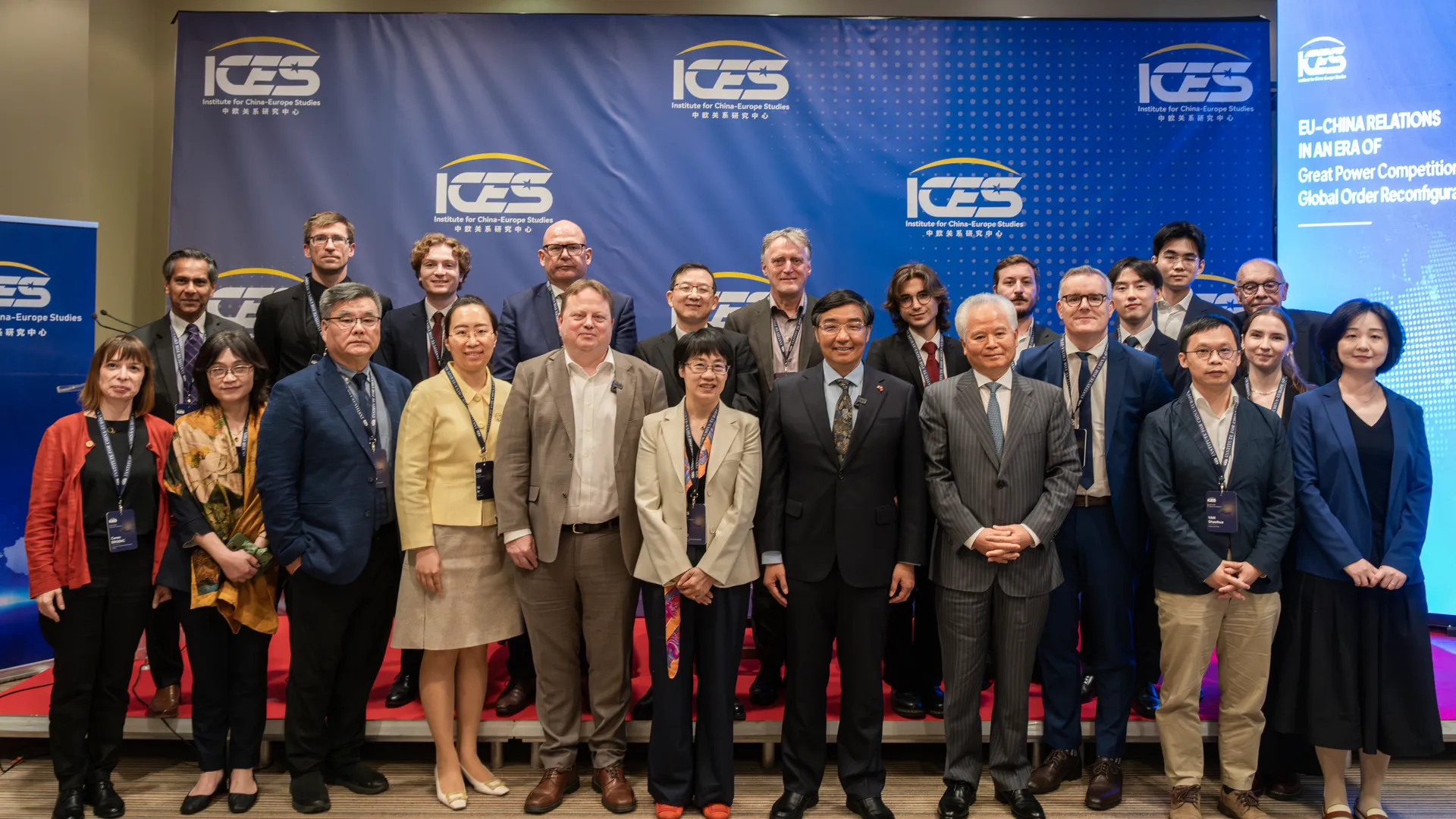
BRUSSELS, BELGIUM — On 10–11 June 2026, the Institute for China-Europe Studies (ICES) convened its inaugural Annual Conference in Brussels, bringing together leading diplomats, academics, and policy analysts for a critical dialogue titled 'EU-China Relations in an Era of Great Power Competition & Global Order Reconfiguration.'
Against the backdrop of a changing global architecture, evolving industrial policies, and shifting dynamics in Washington, the two-day event provided a high-level platform to move beyond zero-sum rhetoric and explore stable, predictable frameworks for China-Europe engagement. Nearly 100 people attended the public conference on 10 June, which was organised in coordination with the Institute for Security & Development Policy (ISDP) at Stockholm, Sweden, the National Institute for South China Sea Studies (NISCSS) from Hainan, China, and the Institute for China-America Studies (ICAS) based in Washington DC, the United States.
Mr. Yang Li, Executive Director of ICES, opened the conference, after which Dr. Wu Shicun, Board Director of ICES, Chairman of the Academic Committee of the NISCSS, and Ms. Joanna Szychowska, Director Asia, Services and Investment, Digital Trade, Intellectual Property and Public Procurement, DG Trade, European Commission, delivered the keynote speeches.
In his remarks, Dr. Wu emphasised the need for dialogue between Europe and China. In the past, economic interdependence served as the stabiliser of China-EU relations. Today, however, economic ties are being increasingly 'securitised', putting pressure on ties between Beijing and Brussels. In his three-decade-long career, Dr. Wu has repeatedly witnessed negotiations hit a deadlock, and the willingness to communicate suffer setbacks. Yet, he has also witnessed how perseverance and professionalism can rebuild trust step-by-step. A primary function of think tanks is precisely to build trust while expanding consensus, and the inaugural ICES conference contributes to this effort.
In her speech, Ms. Szychowska pointed out that while the EU deeply values its interconnected economic links with China, a sustainable dialogue must directly confront reality and yield concrete results. She stressed that current macroeconomic asymmetries and trade friction points between the EU and China require a joint, serious effort to rectify, noting that it ultimately takes both parties to restore a truly balanced and predictable playing field.
H.E. Fei Shengchao, Ambassador of the People's Republic of China to Belgium, stated during the luncheon discussion that China and Europe have no structural reasons to become existential foes, and that their economic competition should be viewed under the healthy framework of the Olympic Games. He dismissed the Western narrative of state-driven 'overcapacity' as an inaccurate characterisation, arguing that Europe's current 'de-risking' restrictions counterproductively block its strongest high-tech exports, essentially forcing Europe to trade with one hand tied behind its back. The luncheon discussion was moderated by Fabian Zuleeg, Chief Executive of the European Policy Centre.
Panel 1: Redefining Economic Security and "De-risking"
The opening panel examined the mechanics of economic resilience, moving past the buzzword of 'de-risking' toward practical economic frameworks. Experts analysed the systemic friction points generated when national security logics spill over into industrial policymaking, transforming what Europe frames as defensive de-risking into what Beijing perceives as proactive protectionism. Participants generally agreed that the EU and China must avoid escalating tit-for-tat tariff cycles, respect their varying internal structural constraints, and look toward bottom-up corporate partnerships to secure sustainable economic coexistence.
Panel 2: Navigating the Trilateral Strategic Triangle
The second panel focused on the 'Third Variable'—the profound impact of US foreign policy on the EU-China relationship. Panellists discussed how the ongoing great power rivalry between Washington and Beijing sets the structural baseline for global trade, forcing both China and the European Union to play highly responsive roles to shifting American geopolitical agendas.
'Europe must not keep the US heavily involved on our continent out of fear of Russia if the price of that involvement is blind alignment against China. Defending European economies against the danger of being overwhelmed by Chinese imports is very important, but it is fundamentally an economic, not a security issue, and it is an issue that must be negotiated directly with Beijing,' noted Dr. Anatol Lieven, Director of the Eurasia Program at the Quincy Institute for Responsible Statecraft.
The discussion underscored that while a stable, long-term agreement between Brussels and Beijing is essential to stabilize this strategic triangle, any such arrangement must navigate the reality of a highly resilient transatlantic alliance. Ultimately, panelists concluded that since China and Europe do not present direct, existential military threats to one another, their industrial competition can remain entirely manageable if both sides exercise strategic patience.
Panel 3: Advancing EU-China Relations through Ocean Stewardship
The third panel transitioned the dialogue toward global commons and maritime governance, examining how global maritime stewardship encapsulates the structural tensions and cooperative necessities defining contemporary EU-China relations across the South China Sea, the Arctic, and critical chokepoints like the Strait of Hormuz.
While disagreements over international norms and legal interpretations under UNCLOS persist, speakers emphasised that ocean governance must not become a zero-sum game. To prevent localised friction from destabilising the global order, the dialogue highlighted a critical need to compartmentalise hard security disputes and leverage technical, data-driven collaboration. By prioritising shared existential vulnerabilities over geopolitical posturing, both actors can find common ground in neutral domains. Viable pathways forward include joint scientific research, implementing the BBNJ treaty, and investing in green shipping technology and climate-resilient port infrastructure. Ultimately, navigating this interdependent maritime landscape requires mutual strategic restraint, technical working mechanisms, and a shared commitment to preserving the global commons.
Panel 4: Bridging Narrative Divides and Cultural Contexts
The final panel turned its focus toward the foundational role that narratives play in conditioning the EU-China dialogue, highlighting how much of the narrative divergence between the two sides hinges on different understandings of the exact same concepts.
For example, while both sides' global narratives embrace multilateralism, European actors broadly understand the term to entail upholding the liberal, rules-based international order through traditional institutions; China, by contrast, connects the term with multipolarity, viewing it as an expression of declining hegemony and a route to a stable, decentralised international order. The panelists also highlighted how identity, insecure historical dependencies, and domestic political economies shape competing international initiatives far more than abstract norms. Over the course of the discussions, speakers noted the potential to transcend detrimental narratives through substantive, joint action to provide public goods where interests overlap, such as confronting climate change and fostering green development in the Global South.
The inaugural conference closed with a clear consensus that sustained Track 2 diplomacy and institutional dialogue remain indispensable tools for navigating this era of great power competition. Participants emphasised that while ideological differences between Brussels and Beijing remain deeply entrenched, the cost of an absolute breakdown in communication is structurally unviable for both societies. Ultimately, within this reconfiguring world order, the EU and China must acknowledge legitimate security boundaries without sacrificing the baseline economic integration and environmental collaboration that supports global stability.
About ICES: Founded in 2020 and operational since 2022, the Institute for China-Europe Studies (ICES) is a Brussels-based independent think tank dedicated to promoting mutual understanding between China and Europe.
Event Details: The ICES Annual Conference took place at Hotel Amigo, Rue de l'Amigo 1, 1000 Brussels on 10–11 June 2026.
Media Contact: Linsheng Hong, Research and Management Associate — linsheng.hong@ices-eu.org
Photos & Multimedia: High-resolution photographs of the panels and speakers are available upon request.