ICES Webinar | European Security and the Roles of China and the USA
Hosted by the Institute for China-Europe Studies (ICES)
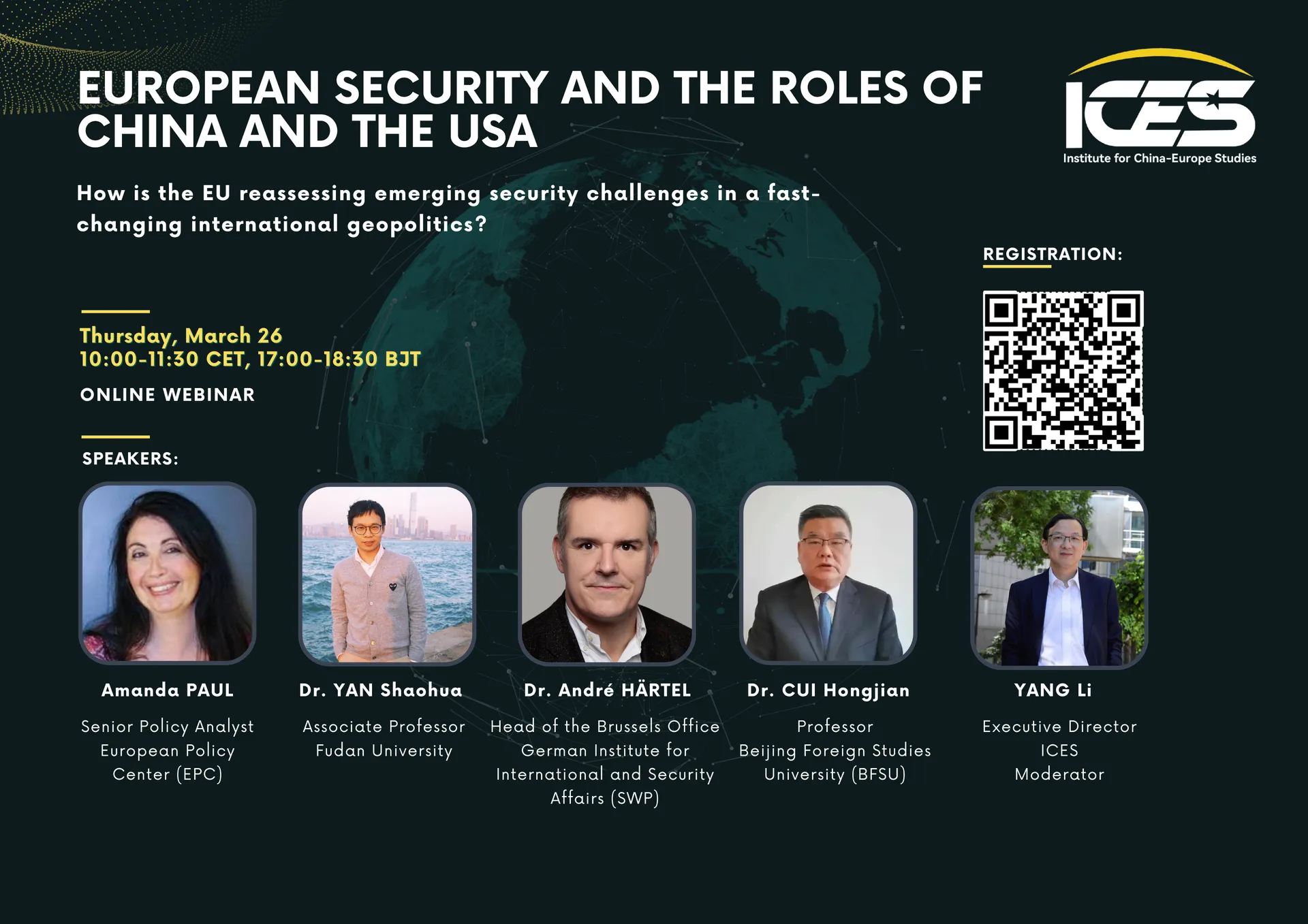
Date: Thursday, March 26, 2026
Time: 10:00 – 11:30 CET
ICES was pleased to welcome:
As security is becoming an all-encompassing concept in Europe and elsewhere in the new global
(dis)order, this ICES Webinar explored the EU’s ambitions for “security to become the
organising principle of action” in the words of Commission President von der Leyen.
The roles of China and the US in this new direction have been and remain crucial, and this
event was the occasion to discuss with both European and Chinese speakers what shape the
future European security architecture might take and how China and the USA will influence it.
All the speakers agreed on the determining role the end of the Russian war will have
on Europe’s security, as well as on the rupture of the transatlantic alliance and its
long-term consequences on the balance of power. In light of the USA’s disengagement and active
threat to Greenland, European speakers emphasised the pressing needs and solutions for Europe
to strengthen their strategic autonomy by diversifying partners, addressing the Russian threat
and enforcing the Draghi’s report’s recommendations. Chinese speakers, on the other hand,
stressed we were now in a new world order in which the USA is accelerating to prioritise its
own interest without coordinating with its traditional partners, and the reinforced necessity
to strengthen China-Europe security cooperation in a constructive manner.
One main
point of frank and lively debate emerged between the speakers on the issue of Russia and the
future of Ukraine, as European experts tend to interpret China’s tacit support to Russia
economically, geopolitically and narratively on the world stage as detrimental to European
interests and EU-China relations. Chinese academics on the other hand, insisted on the fact
that China’s position towards the Russia-Ukraine war is more complex and neutral than
presented in European circles, highlighting the humanitarian support brought to Ukraine, the
tendency for Europe to apply Western worldviews onto Chinese foreign policy decisions and the
constructive talks that could instead benefit a crisis resolution in the region.
Overall however, both Chinese and European speakers agreed on the value such exchanges
represent to foster better understanding and trust between the EU and China.
We
extend our sincere thanks to the speakers for their insightful contributions and sometimes
lively debate and to our engaged audience for their participation.
If you were unable to follow the discussion live, we invite you to watch the full recording via: https://youtu.be/HmIzuH4SA_E