ICES Webinar | From Hormuz to High Seas Governance: New Challenges for the International Law of the Sea and China-EU Responses
Hosted by the Institute of China-Europe Studies
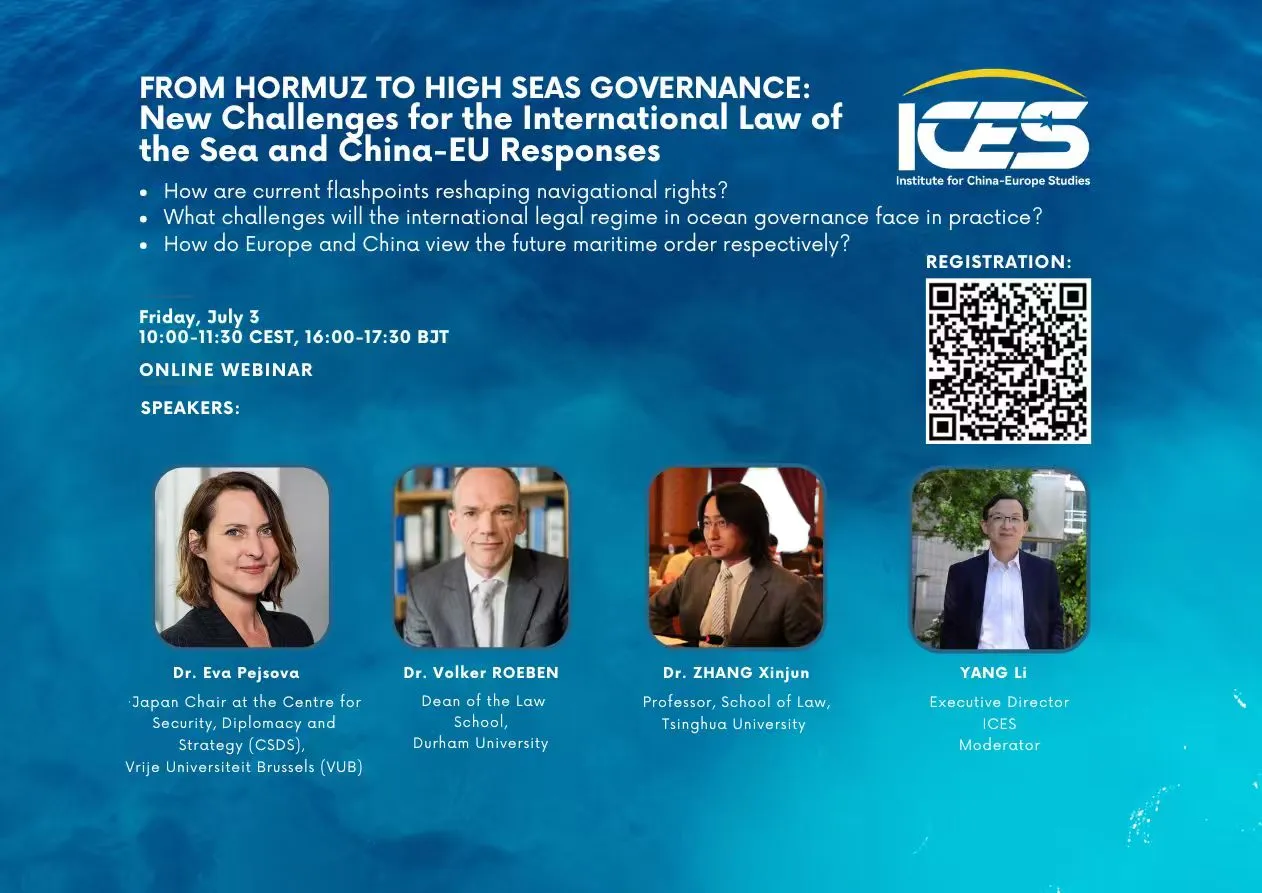
Source: ICES
Date: Friday, July 3, 2026
Time: 10:00–11:30 CEST; 16:00–17:30 BJT
Speakers (in alphabetical order of surname):
- Dr. Eva Pejsova, Japan Chair at the Centre for Security, Diplomacy and Strategy (CSDS), Vrije Universiteit Brussels (VUB)
- Professor Volker Roeben, Dean of the Law School, Durham University
- Professor ZHANG Xinjun, Professor, School of Law, Tsinghua University
Moderated by ICES' Executive Director YANG Li
Four decades after the 1982 UN Convention on the Law of the Sea (UNCLOS) was adopted, the seas have become a site of sharpening geopolitical and geoeconomic contestation, and a frontier of scientific and technological opportunity—from the renewed salience of transit passage rights amid the Middle East conflict, to the strategic questions raised by deep-sea mining and critical raw materials. Against this backdrop, ICES hosted a webinar with several esteemed European and Chinese scholars to discuss what role the EU and China could play in upholding and adapting the international legal order for the oceans.
Dr Eva Pejsova argued that the most important issues on which the EU and China need to work together are consistently being hijacked by geopolitical rivalry, which crowds out cooperation on what should be treated as a common good. She pointed to the recent crisis in the Strait of Hormuz as a stark illustration of the gap between law and practice: unimpeded transit passage is a clear legal right, but the law of armed conflict at sea adds a further layer of complexity, and an interdiction of this kind inevitably affects neutral parties. More broadly, she described the maritime order as caught between a sovereignty-based reading favoured by coastal states and a freedom-based reading favoured by user states, with the former treating marginal seas as sovereign and the Exclusive Economic Zones (EEZ) increasingly functioning as a de-facto security buffer. Her recommendation was to securitize specific conduct—acts of sabotage, spoofing, coercion—rather than geographical space itself. On governance, she noted that UNCLOS remains far from obsolete and is still the primary anchor for the oceans, even as new layers such as the BBNJ Agreement and International Seabed Authority's deep-sea mining code create fresh friction.
Dr Zhang Xinjun's central point was that the law of the sea is being actively applied and developed under pressure, illustrated through two case studies. On the Strait of Hormuz, he noted that Iran has not ratified UNCLOS and appears to treat its side of the strait as territorial sea subject to innocent passage rather than full transit passage; even setting aside the transit-passage argument, however, Iran cannot lawfully suspend innocent passage in peacetime. He suggested the way forward lies in institutional design—a bespoke mechanism that accounts for Iran's particular economic and security position, with room for EU and Chinese contribution. Turning to Baltic Sea cable-sabotage incidents, he explained that while UNCLOS grants coastal states rights over marine resources and pollution, submarine cables do not fit neatly into this framework and require case-by-case interpretation. Here, recent precedent is shaping an emergent principle of "due regard," that balances flag-state and coastal-state interests, although the EU and China take divergent sides in this debate.
Dr Volker Roeben observed that the law governing straits and chokepoints is difficult precisely because different regimes apply in different contexts—for example, the Suez Canal is internal waters, while the Danish Belts were subject to tolls for a long period before those were unilaterally rescinded. He highlighted the International Tribunal for the Law of the Sea (ITLOS) as a key mechanism for resolving present uncertainties such as strait transit, submarine cable governance, and 'shadow fleet' interdiction. In his view, ITLOS has kept UNCLOS "alive" through active interpretation: no one anticipated climate change as a major issue when the Convention was drafted in the 1970s, yet the framework has proven adaptable.
Finally, the speakers agreed on the practical value of legal certainty and continued dialogue, even without full agreement. While the "due regard" principle displays promising signs of an amenable compromise, it remains a case-by-case obligation of conduct rather than a fixed, 'one-size-fits-all' answer to how jurisdiction ought to be allocated: and real distance exists here between Brussels and Beijing. Nevertheless, genuine shared interests in open sea lanes, energy and transport security, secure digital infrastructure, and sustainable biodiversity governance give both sides reason to keep talking. On the highest-stakes issues—namely, the development of an ad-hoc arrangement for Hormuz—peace remains the primary goal, and, as much as a lasting solution remains dependent on great-power dynamics beyond the control of legal scholars, Europe and China both can bring diplomatic, technical, and legal expertise that can help build the trust and shared information such an arrangement would require.
We extend our sincere thanks to the speakers for their insightful contributions and expertise and to our engaged audience for their participation. ICES looks forward to convening further discussions on these questions in the months ahead.
If you were unable to follow the discussion live, we invite you to watch the full recording
via:
https://youtu.be/v4VCyKx19_4