ICES and ICAS Webinar | Trump's Visit to China: Key Takeaways for U.S.-China-Europe Relations
Hosted by the Institute for China-Europe Studies (ICES) and the Institute for China-America Studies (ICAS)
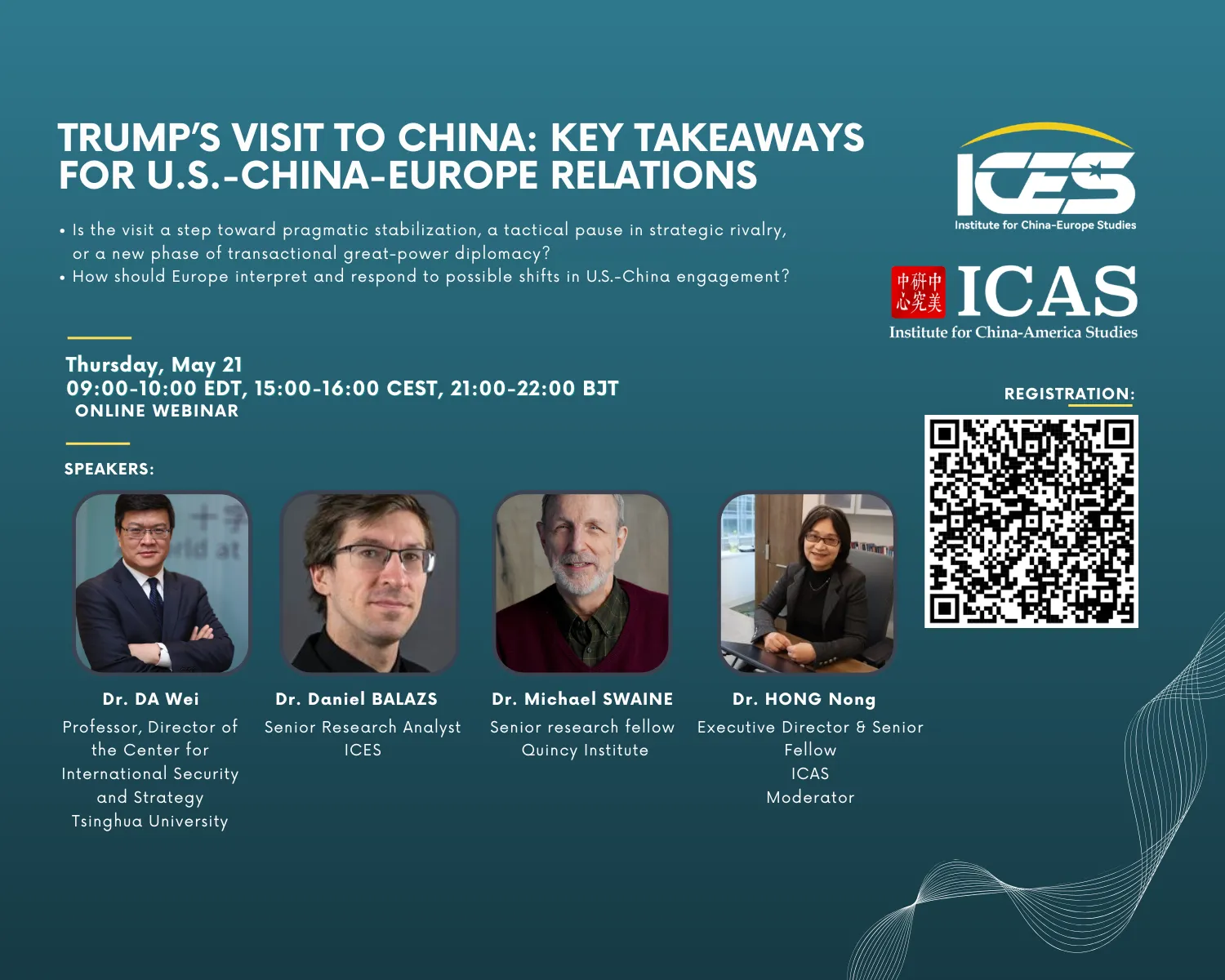
Date: Thursday, May 21, 2026
Time: 15:00–16:00 CEST (09:00–10:00 EDT, 21:00–22:00 BJT)
ICES was pleased to welcome:
- Dr. DA Wei, Professor, Director of the Center for International Security and Strategy, Tsinghua University
- Dr. Daniel BALAZS, Senior Research Analyst, ICES
- Dr. Michael SWAINE, Senior Research Fellow, Quincy Institute
With opening remarks from YANG Li, Executive Director, ICES
The event was moderated by Dr. HONG Nong, Executive Director & Senior Fellow, ICAS
President Donald Trump's visit to China came at a consequential moment for U.S.-China relations and the wider international order. After years of strategic competition, economic tension, technology restrictions, and growing geopolitical mistrust, the visit offered an important opportunity to assess whether Washington and Beijing are moving toward a more stable framework of engagement — or simply managing competition through temporary understandings. ICES and ICAS were honoured to host a webinar that explored the expectations, highlights and consequences of the Trump-Xi summit on EU-China relations.
Dr Michael Swaine underscored the very limited achievements of the event, namely the lack of concrete details on future deals between the two countries, and what amounted more to an uneasy truce and strategic stability than a grand bargain or reconciliation. The key words after the summit being used ("Constructive strategic stability") showcased that the underlying conflicts and issues between the two sides have not really been resolved and the summit was more of a pause than a reset. Tactical cooperation is thus to be expected but competition is set to last. On the European front, Europe is likely to pursue hedging when it comes to security guarantees from the USA while it raises its own security spending, and to try and keep on derisking its economy from China.
Dr Da Wei spoke on the expectations of the Chinese analysts and political experts, and how considering they were quite low, the meeting actually went better than expected, especially since at least three more meetings between the leaders are supposed to take place, including a state visit from Xi Jinping later this year in the USA. Dr Da also spoke about the contrasting expectations of American and Chinese officials when it comes to negotiations, with the former expecting a bottom-up approach, ranging from concrete issues to reach an overall deal, while the latter is more used to holistic agreements with strategic reassurances first, that will then trickle down to specifics. Interestingly, the White House communication after the summit was remarkably more aligned with the Chinese-style of negotiation than usual.
Dr Daniel Balazs highlighted that competition on the economic front is bound to continue, and while Europeans were wary of a grand bargain between the two powers that would have left them on the sidelines, existing deals and the prospect of closer economic coordination between Washington and Beijing could still negatively affect Europe. As a result, Europe-China relations are unlikely to change radically from the de-risking agenda on the European side, and the countermeasures of such defence mechanisms on the Chinese side. Actually, the Chinese approach could actually be consolidated by the summit, and Europe seems ready to be opening new fronts in derisking with new tools and measures evoked in recent days.
Finally, the speakers agreed on the fact that the Taiwanese issue will be of the key tests of the China-US relation, and Europeans will watch closely as the consequences on their own relations with both powers could be dramatically upended in case of a conflict. The issues of rare earths, AI innovation race and the impetus for Europe to reinforce both its economic and security independence were also mentioned, as well as the fragmented global order in which bilateral agreements and nationalism trends are increasingly the norm again.
We extend our sincere thanks to the speakers for their insightful contributions and expertise and to our engaged audience for their participation.
If you were unable to follow the discussion live, we invite you to watch the full recording
via:
https://youtu.be/DYrAZscKqws