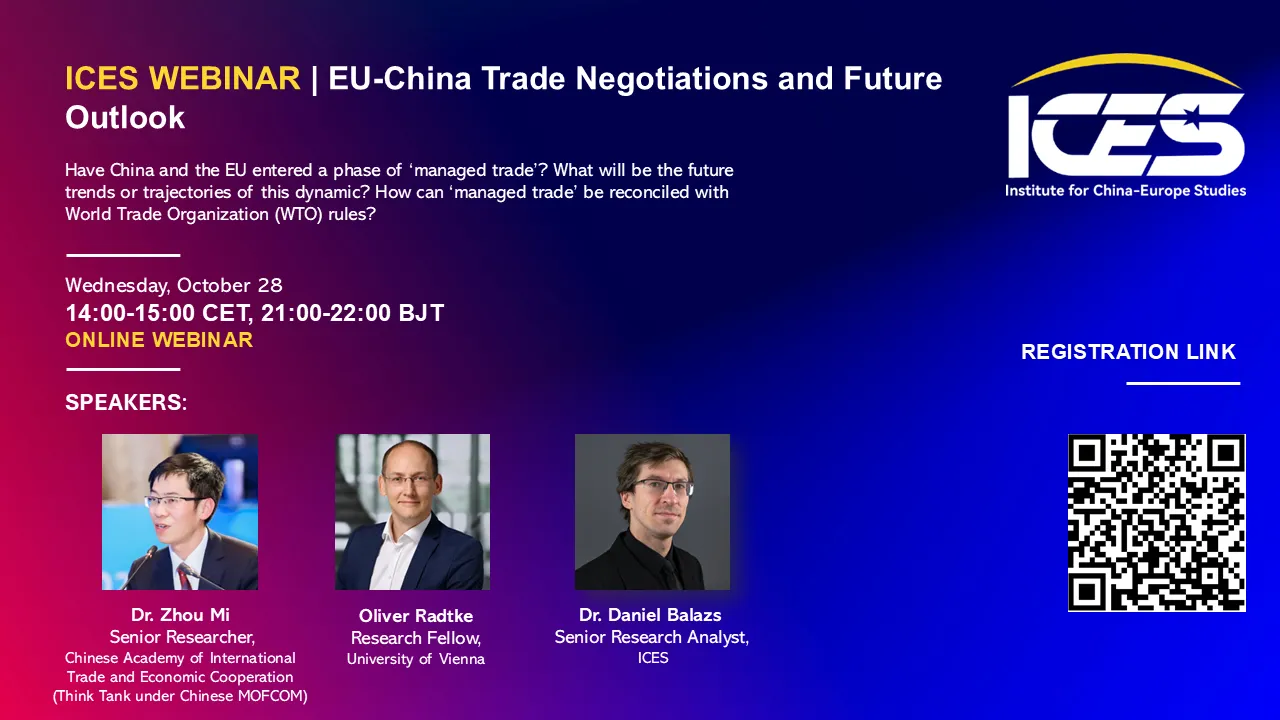
ICES Webinar | EU-China Trade Negotiations and Future Outlook
Hosted by the Institute of China-Europe Studies (ICES)
Source: ICES
Date: Wednesday, October 28, 2026
Time: 14:00–15:00 CET, 21:00–22:00 BJT
Speakers:
- Oliver Radtke, Research Fellow, Department of East Asian Studies, University of Vienna
- ZHOU Mi, Senior Researcher, Chinese Academy of International Trade and Economic Cooperation – the think tank under the Ministry of Commerce (MOFCOM) of the People's Republic of China.
Moderated by Daniel Balazs, Senior Research Analyst at ICES
Summary
Dr Balazs started by introducing the results from the latest EU-China Trade and Investment Consultations (TIC) and the key agreements they yielded, most notably on hybrid cars, rare earths and European exports to China.
Dr Zhou then reminded the audience that the results from the TIC allowed for some optimism on future negotiations, and that compromises could be found on either side. The current agreements offered strong signals to the market, something all the more important considering that policy alone cannot determine trade behaviours, despite what some commentators sometimes expect regarding China. Another positive aspect is that the EU and China still seem to uphold World Trade Organisation values and rules, and by leading by example, other nations are more likely to follow suit. In short, escalation was averted, but a long way to go remains for future negotiations.
Mr Radtke agreed that negotiations were necessary for both sides, but the understandings reached so far have not amounted to an overarching deal that addresses concerns of both sides. He underlined the differences in EU and Chinese takeaways from the meetings, from the contested number of hybrid vehicle exports' future trends to the differences in the readouts of the consensus found. Mr Radtke, however, remained optimistic, as these negotiations laid the groundwork for future talks and succeeded in de-escalating tensions.
Responding to questions from the audience, both speakers agreed that trade commissioner Maroš Šefčovič had managed negotiations quite well under severe time constraints, and that the results of the TIC constituted a good start, but that overall progress will remain incremental. On what would constitute a good outcome for future TICs, the speakers argued that negotiations would benefit from the familiarity developed between negotiators and that it might be affected by US-China relations. Concerning tariffs on Chinese EVs and PHEVs, they pointed out that while political developments within member states could influence the overall EU stance, the Chinese investments in those factories, companies and the number of jobs created mean that going too clearly against that segment of the population would be politically disastrous, and that large projects often take precedence over short-term political changes. It will remain interesting, however, to see how new Chinese regulation over outward investments will impact technology transfer and innovation cooperation between China and the EU.
Speakers concluded by elaborating on what each side’s eventual goals are: for the EU, to lower its trade imbalance with China and to benefit from its investments, and for China to strengthen and stabilise its relationship with the EU, making it mutually beneficial, and not only in traditional sectors.
If you were unable to follow the discussion live, we invite you to watch the full recording
via:
https://youtu.be/U6hghSgJ9GM